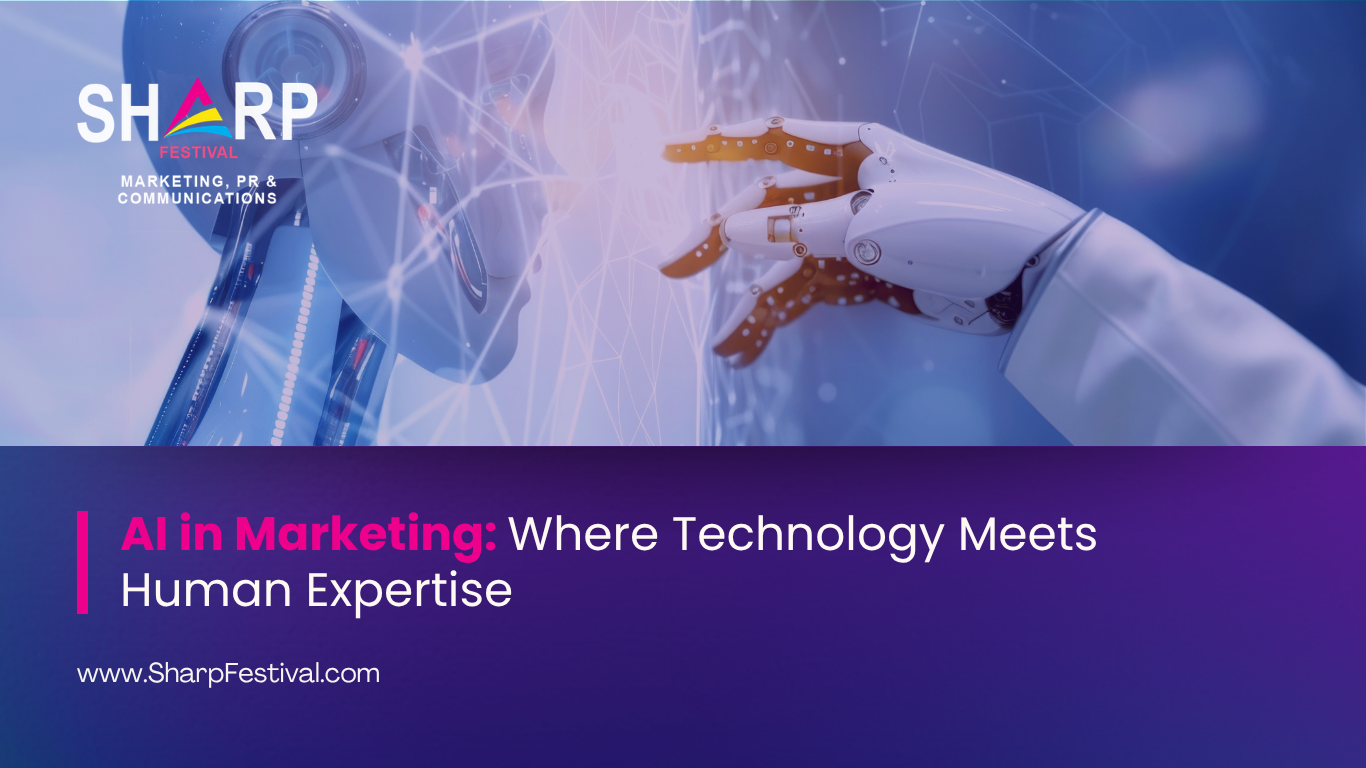
AI in Marketing: Where Technology Meets Human Expertise
Artificial intelligence has quickly become part of the modern marketer’s toolkit. It can help teams analyse large amounts of information, identify patterns in customer behaviour, generate content ideas, support research, automate repetitive tasks and assist with campaign planning. For many marketing teams, AI is no longer something to consider in the future. It is already becoming part of everyday work.
Yet adopting AI is not simply a question of learning which tools to use.
The more important question is how marketers use those tools effectively. AI can process information at remarkable speed, but it does not automatically understand a brand, a customer, a market or the wider context surrounding a business decision. It can generate an answer, but that does not necessarily mean the answer is appropriate. It can suggest an idea, but it cannot replace the experience required to understand whether that idea will work for a particular audience.
This is where human expertise becomes particularly important.
The future of AI in marketing is unlikely to be about choosing between technology and people. Instead, it is about understanding where AI can strengthen the work marketers already do, while ensuring that creativity, experience, critical thinking and professional judgement remain part of the process.
AI is changing the marketer’s toolkit
Marketing has always involved a combination of creativity, research, analysis and decision-making. AI is changing how many of these activities are carried out.
Research that once took hours can often be accelerated with AI. Large volumes of customer feedback, campaign data or market information can be processed more quickly. Marketers can use AI to identify themes, organise information, explore potential audiences or generate starting points for further research.
Content production has also changed. AI can help marketers develop initial ideas, create outlines, explore different messaging approaches, adapt copy for different audiences and speed up parts of the production process.
Campaign planning is another area where AI can provide support. Marketers can use AI to explore potential customer segments, analyse previous campaign performance, identify patterns and generate ideas for testing.
None of this means that the marketer’s role becomes less important. In many cases, it changes the nature of the work.
Instead of spending as much time on repetitive tasks, marketers can spend more time interpreting information, developing ideas, questioning assumptions and making decisions. The value comes from knowing how to use technology as part of the process rather than allowing the technology to determine the process.
Knowing how to use AI is only the beginning
There is a growing focus on AI skills across marketing teams, and for good reason. Professionals need to understand how different tools work and how they can be applied to practical marketing tasks.
However, technical familiarity alone is not enough.
A marketer may know how to generate an audience analysis using an AI tool, but they still need to understand whether the information is reliable. They may know how to produce ten campaign concepts in a few minutes, but they still need to decide which ideas fit the brand and which should be rejected.
The same applies to content.
AI can produce grammatically correct copy very quickly. It can also imitate different tones, summarise information and generate multiple versions of a message. But good marketing is not simply about producing words efficiently. It is about knowing what the brand should say, why it should say it and how the audience is likely to respond.
That requires context.
Human expertise provides much of that context.
Experience gives information meaning
One of the biggest differences between AI and an experienced marketer is the ability to interpret information within a wider business and cultural context.
A report might show that one campaign generated more clicks than another. AI can help identify that difference and explore possible reasons. But understanding what the result means for the organisation may require knowledge of the brand, its customers, its competitors and its previous activity.
Numbers can show what happened. They do not always explain what should happen next.
An experienced marketer can ask questions that are difficult to reduce to a dataset.
Was the campaign successful because the creative idea was stronger, or because the offer was more attractive? Did the audience respond positively to the brand message, or were there external factors influencing behaviour? Is a particular trend meaningful, or is it simply a temporary change in the data?
These questions require judgement.
AI can support the analysis, but marketers still need to decide how much confidence to place in the information and how it should influence the next decision.
Creativity still has an important role
AI has also created an interesting tension around creativity.
Generative AI can produce campaign concepts, headlines, images, scripts and content variations at an impressive speed. This can help creative teams move from a blank page to a range of possibilities much faster.
But producing ideas is not the same as producing a strong creative idea.
A memorable campaign usually has something behind it: a clear observation, an understanding of the audience, a distinctive perspective or a simple idea that connects with something people already understand or feel.
AI can help marketers explore possibilities, but human creativity is still needed to decide which ideas are worth developing.
This is particularly important for brands competing for attention in crowded markets. If every organisation uses similar tools, follows similar prompts and produces similar types of content, efficiency alone will not create differentiation.
Marketers still need to ask what makes an idea distinctive and whether it gives people a reason to remember the brand.
AI can make marketers more efficient, but efficiency is not the same as effectiveness
One of the most obvious benefits of AI in marketing is efficiency.
Tasks that previously required significant amounts of manual work can often be completed more quickly. Research can be organised, information can be summarised, content can be adapted and repetitive processes can be automated.
This creates an opportunity for marketing teams to use their time differently.
Instead of spending hours preparing a first draft, a marketer might use AI to create a starting point and then spend more time improving the message. Instead of manually sorting large quantities of feedback, a team could use AI to identify recurring themes and then investigate the findings in greater depth.
The distinction between efficiency and effectiveness is important.
Doing something faster does not automatically make the marketing better. If a team produces twice as much content but none of it is relevant to the audience, productivity has increased without creating greater value.
AI should therefore be viewed as a way to improve parts of the marketing process, rather than as a replacement for strategic thinking.
The importance of questioning AI outputs
AI systems can produce confident answers even when the underlying information is incomplete, inaccurate or misunderstood.
For marketers, this creates a responsibility to question the output rather than accepting it automatically.
A useful AI workflow should include verification. Facts need to be checked. Sources need to be considered. Assumptions need to be challenged. Generated content needs to be reviewed before it reaches customers or other stakeholders.
This becomes particularly important when marketing activity involves sensitive subjects, regulated industries, corporate reputation or complex audiences.
Professional judgement acts as a quality control layer between what a tool produces and what an organisation ultimately communicates.
That role becomes even more important as AI becomes easier to use.
When technology becomes accessible to almost everyone, the differentiator may be less about who can access the tool and more about who knows how to use it responsibly and intelligently.
Brand knowledge cannot simply be automated
Every brand has its own history, positioning, customers, culture and reputation.
An AI tool can be given information about a brand, but that does not mean it automatically understands everything that makes the brand distinctive. It may identify patterns in previous communications, but marketers still need to understand whether those patterns should continue.
Brand strategy requires decisions about what an organisation wants to stand for and how it wants to be perceived.
Those decisions are closely connected to business strategy and leadership.
AI can support the process by providing research, analysis and ideas, but it should not determine the brand’s identity. The responsibility for those decisions remains with the people leading the brand.
This is particularly important when organisations are using AI to produce large amounts of content. Without clear strategic direction, efficiency can lead to inconsistency, repetition and diluted brand identity.
Customer understanding requires more than data
AI can help marketers understand customer behaviour at a scale that would be difficult to achieve manually. It can identify patterns across large datasets, segment audiences and highlight common themes in customer feedback.
But customers are not simply collections of data points.
People make decisions based on emotion, experience, culture, relationships, circumstances and expectations. Their behaviour can change depending on context.
This is why customer insight requires both data and human interpretation.
A marketer might use AI to identify that customers are abandoning a particular stage of the buying journey. The next step is understanding why. The answer may involve pricing, messaging, trust, usability, timing or an issue that is not immediately visible in the data.
AI can help marketers find the signal. Human expertise helps determine what that signal means.
Marketing teams need better questions, not simply better tools
The rapid growth of AI has created a tendency to focus on tools.
Which platform should we use? Which model is most effective? How can we automate this task? How can we generate more content?
These are useful questions, but they should not come before the marketing problem itself.
A stronger starting point is often:
What are we trying to achieve?
Once the objective is clear, teams can determine whether AI can genuinely improve the process.
If the goal is to understand customer feedback, AI may help analyse large volumes of responses. If the goal is to develop creative concepts, it may provide useful starting points. If the goal is to improve campaign performance, it may help identify patterns in existing data.
But not every marketing challenge needs an AI solution.
Sometimes the most useful action is a conversation with a customer, a creative workshop, a review of the brand strategy or a discussion between people from different parts of the organisation.
Good marketing depends on knowing the difference.
Leadership has an important role to play
The way organisations adopt AI will also depend heavily on marketing leadership.
Leaders need to create an environment where teams can experiment with new technology while understanding the responsibilities that come with it.
This includes establishing clear expectations around data, privacy, intellectual property, brand standards, accuracy and human review. It also means allowing marketers to develop both technical and strategic skills.
AI should not become a separate technical project that sits outside the wider marketing strategy.
It needs to connect with the way teams work, the goals they are trying to achieve and the experience they want to create for customers.
Leadership also has an important role in preventing two extremes: treating AI as a solution to every problem or resisting it completely.
Neither approach gives marketing teams a particularly useful framework for deciding where technology belongs.
The marketer of the future will need both technical and human skills
As AI becomes more integrated into marketing, the skills required from professionals are likely to become broader.
Understanding AI tools will be useful, but so will the ability to interpret information, challenge outputs and make decisions when there is no obvious answer.
Strategic thinking, creativity, communication, audience understanding and commercial awareness remain important. In many cases, their value increases because technology can now handle more of the repetitive work surrounding them.
Marketing professionals therefore need to become comfortable working alongside AI without becoming dependent on it.
The strongest teams will not necessarily be the ones producing the most AI-generated content. They may be the ones that understand where technology creates genuine value and where human involvement makes the difference.
A more balanced approach to AI in marketing
The conversation around AI in marketing can sometimes become overly focused on what the technology can do.
A more useful question is what marketers can do with it.
AI can help teams research faster, analyse more information, explore ideas, automate repetitive tasks and improve the efficiency of campaign development. These are meaningful advantages.
At the same time, marketers still need to bring experience, creativity, critical thinking and judgement to the process. They need to understand their audiences, protect their brands, question assumptions and make decisions that connect marketing activity with wider business objectives.
The relationship between AI and human expertise is therefore less about replacement and more about collaboration.
Technology can expand what a marketing team is capable of doing. Human expertise determines how that capability is used.
What should marketing teams focus on next?
For organisations developing their approach to AI, the starting point does not need to be a long list of new tools. It can be a closer look at the work the team is already doing.
Identify repetitive tasks that could be automated. Look at areas where large amounts of information need to be analysed. Consider where AI could help teams explore ideas or work more efficiently.
At the same time, identify the decisions that require deeper human involvement.
These might include brand positioning, creative direction, reputation, customer relationships, sensitive communications and strategic decisions that depend on organisational context.
The aim is not to remove people from the process. It is to give people better tools while keeping responsibility for important decisions where it belongs.
AI in Marketing: Where Technology Meets Human Expertise
AI will continue to change the way marketing teams work. The technology will become more capable, the range of applications will expand and new tools will continue to enter the market.
For marketers, however, the central challenge will remain familiar: understanding people and finding meaningful ways to connect with them.
AI can help marketers work with more information, move faster and explore more possibilities. Human expertise provides the context, judgement and creativity needed to turn those possibilities into effective marketing.
The most useful approach is therefore not to ask whether AI or human expertise is more important. Marketing needs both.
The opportunity lies in building teams that know how to combine the speed and analytical capabilities of AI with the experience, curiosity and judgement of people.
That balance will be an important part of the conversation around the future of marketing.
Explore AI and Marketing Strategy at SHARP Festival 2027
AI, creativity, data, strategy and human expertise will be among the themes explored at SHARP Festival 2027, taking place from 10–14 May 2027 in London.
The festival brings together marketing, PR, communications and business professionals to explore practical ideas, emerging technologies and the decisions shaping the way organisations communicate and grow.
Explore the programme and discover more about SHARP Festival 2027.
Frequently Asked Questions
How is AI being used in marketing?
AI is being used across marketing for research, data analysis, customer insights, content development, campaign planning, automation, personalisation and performance analysis. Its role varies depending on the organisation and the specific marketing objective.
Can AI replace marketing professionals?
AI can automate or support many marketing tasks, but marketing still requires strategy, creativity, audience understanding, critical thinking and professional judgement. Human oversight remains important, particularly for strategic, creative and reputation-sensitive decisions.
Why is human expertise important when using AI in marketing?
Human expertise provides context and judgement. Marketers need to assess whether AI-generated information is accurate, relevant to the audience, appropriate for the brand and useful for the wider business objective.
How can marketers use AI without losing creativity?
AI can be used to support research, generate starting points and explore different possibilities, while marketers remain responsible for the creative direction and final decisions. The technology can accelerate parts of the process without determining the idea itself.
What skills will marketers need as AI develops?
Alongside AI literacy, marketers will continue to need strategic thinking, creativity, communication, data interpretation, customer understanding, critical thinking and decision-making skills. The ability to question and evaluate AI outputs will also become increasingly important.
What should businesses consider before adopting AI in marketing?
Businesses should consider their objectives, data quality, privacy, security, intellectual property, brand standards, accuracy and human oversight. They should also identify where AI can create genuine value rather than adopting technology simply because it is available.